Our Way – full strategy to delivery
Our Way – Strategy to delivery (13MB pdf)
Our Way – summary
Introducing ‘Our Way’
- The Our Way strategy, published 01 April 2026, sets out a five-year approach to
commissioning built on a single, defining principle: quality is the strategy. - Improving quality—access, experience, outcomes, and effectiveness —is the
mechanism through which we will deliver a sustainable NHS for our population.
Our purpose
- Our purpose is to steward an £8.5bn budget, managing the clinical and financial riskfor the 3.5 million people we serve.
- We will focus relentlessly on what matters most to people and to the system.
- Improving access to care so that services are easier to navigate, more local, and feel simpler and more joined up from a person’s perspective.
- Making the NHS financially sustainable and more productive, using resources where they deliver the greatest value and reducing low-value activity. We will do less of what does not add value, and more of what does.
- Support people to stay in work and remain economically active wherever possible. We need to design care that helps people recover, manage long term conditions, and continue to participate in society.
How we will work: Improve, Codify, Scale
- Our approach is disciplined and repeatable: improve it, codify it, then scale it.
- We will test changes at a small scale to prove impact, guided by evidence, insight, and the voices of the communities we serve.
- If shown to work, we will codify it into a standard, evidence-based model and then commission it once at scale, using lead provider and collaborative models.
- Not everything works everywhere. We will apply an 80:20 principle: best practice is the default, with local variation where there is an evidence-based reason.
Neighbourhood Health Teams: The Anchor for Place-Based Delivery
- Neighbourhood Health provides the operational level prevention, proactive care, coordination, and crisis response are integrated around people and places.
- Primary and community health services will act as the anchor of neighbourhood delivery, providing continuity, proactive management of long-term conditions, and coordination across pathways
- This year, our priority is to establish a strong Neighbourhood Health Team contract through a lead provider model, bringing together primary care, community services, mental health, VCSE, and local authorities around a single neighbourhood offer.
Our Care Model: A Single Framework for Quality
- Delivery will be shaped by a single care model that applies across all ages, all
providers, and all pathways. We see five clear stages:- Prevention and screening – reduce future morbidity, avoidable deterioration, and unwarranted demand on NHS services.
- Supported self-care – Where people can safely manage their own health, the system should enable and support them to do so.
- Proactive risk identification and outreach – Rather than waiting for people to present in crisis, we will prioritise proactive outreach to individuals and groups at risk of deterioration or avoidable service use.
- Care coordination for complex needs – For people with multiple conditions, frailty, or complex needs, care is actively coordinated around the individual.
- Crisis response linked to recovery – For people with multiple conditions, frailty, or complex needs, care is actively coordinated around the individual.
We will measure what matters
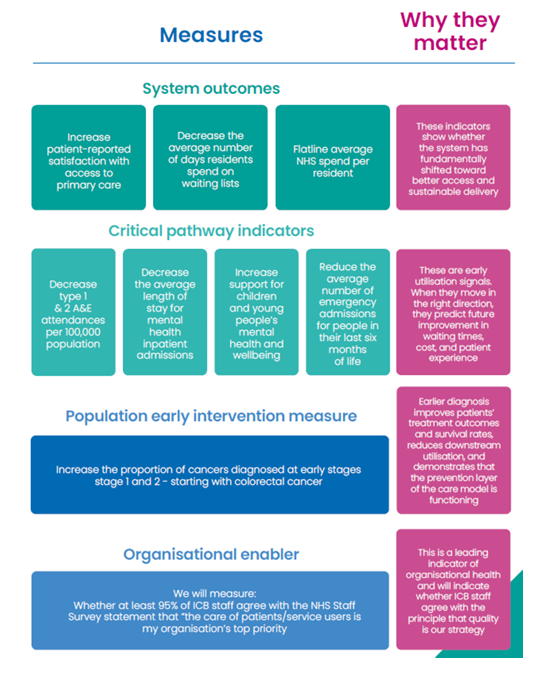
- We will measure whether the strategy is delivering what it is intended to achieve: better quality, lower avoidable utilisation, and a financially sustainable NHS.
- Key measures are deliberately few to ensure focus. Figure One below – “Measuring What Matters” sets out the priority areas. Our top three system outcomes are:
- Increase patient-reported satisfaction with access to primary care;
- Decrease the average number of days residents spend on waiting lists; and,
- Flatline average NHS spend per resident.
Figure One: Measuring What Matters, Our Way Strategy, Central East ICB
We will begin delivery with Five Priority Programmes
- These are chosen because they address major population needs, offer clear
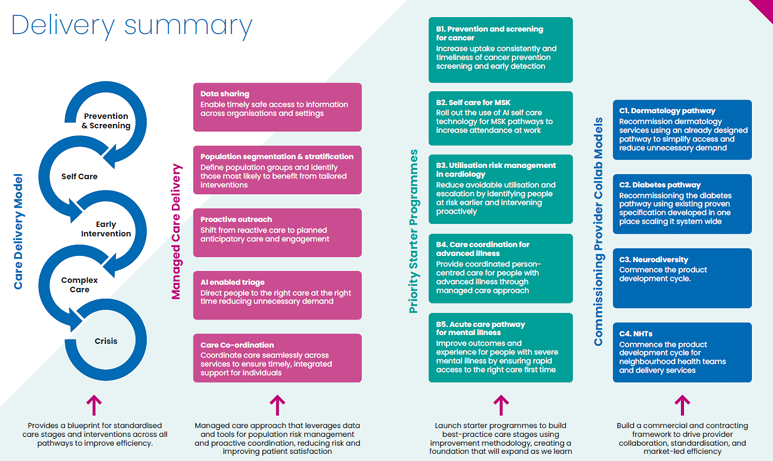
opportunities to reduce utilisation, and already have evidence or proven elements.- Prevention and screening for cancer – Increase uptake consistently and timeliness of cancer prevention screening and early detection
- Self-care for MSK – Roll out the use of AI self-care technology for MSK pathways to increase attendance at work
- Utilisation risk management in cardiology – Reduce avoidable utilisation and escalation by identifying people at risk earlier and intervening proactively
- Care coordination for advanced illness – Provide coordinated person centred care for people with advanced illness
- Acute care pathway for mental illness – Improve outcomes and experience for people with severe mental illness, ensuring rapid access to the right care
- Figure Two below – Delivery Summary – presents our priority programmes
alongside the key areas in which we will drive closer provider collaboration.
Figure Two: Delivery Summary, Our Way Strategy, Central East ICB